The Tall Office Building Artistically Considered
2014 | 20'
Text by Patrick Eakin Young and Orlando Wells
Commissioned by Erratica
Chamber Opera for five voices and electronics
Part III of Triptych
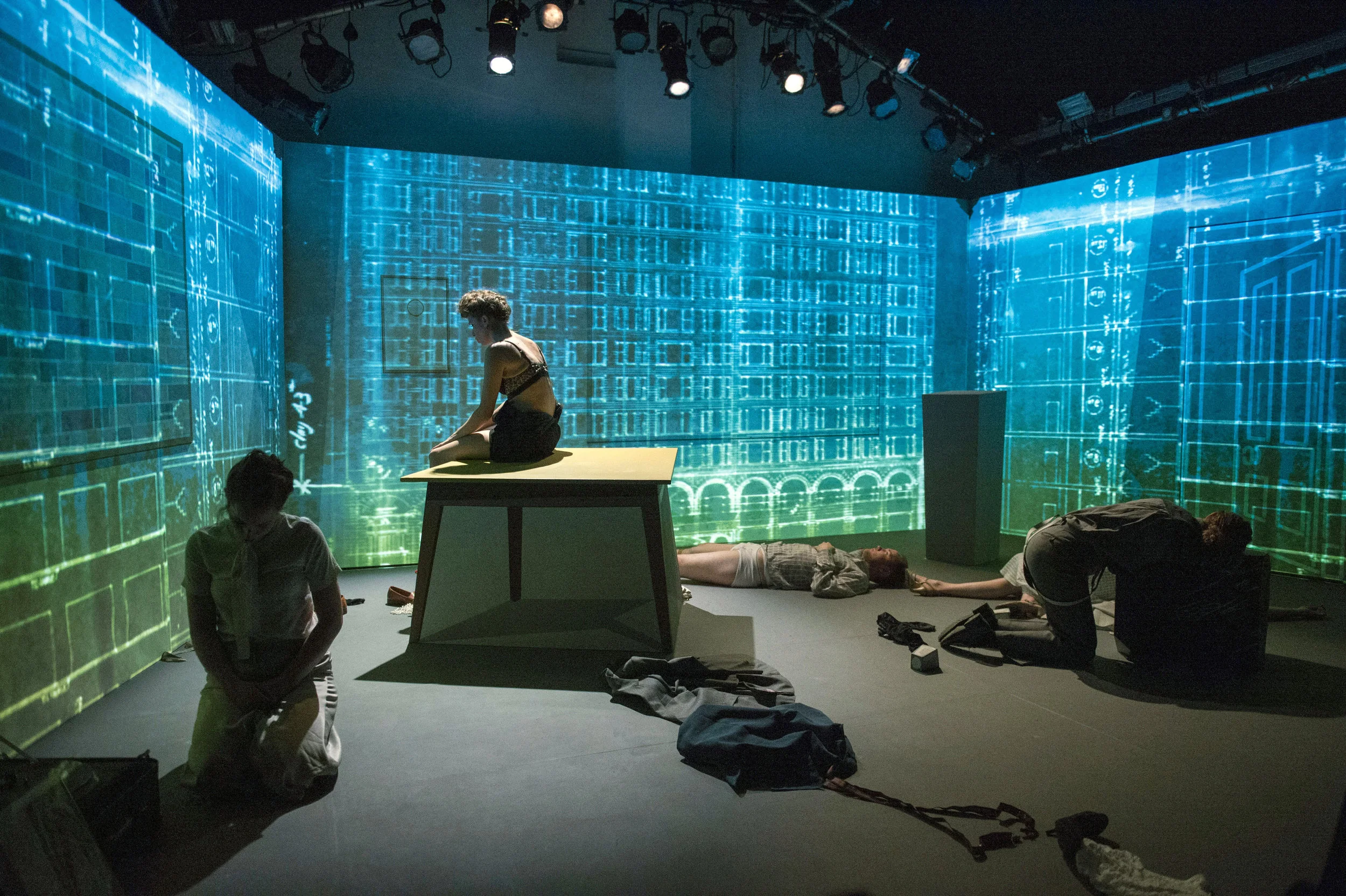
I first encountered the story of Richard Nickel in a poem by Jonathan Williams. The poem is extremely short and consists entirely of found text from the writings of architect Louis Sullivan:
a flower appears
amid the leaves
of its parents plant
It’s fitting that this poem about Nickel is expressed exclusively through the words of Sullivan. Nickel’s life work was the photographic documentation of Sullivan’s buildings and in each of the photographs, we see the artistry of Sullivan expressed through the lens of Nickel. Nickel’s own voice is subsumed by Sullivan’s in these wide shots of grand victorian banks and theatres and close ups of intensely detailed architectural ornament. But the photographs have both a real human warmth and an incisive clarity that are clearly the work of Nickel. This piece is an attempt to reveal something of this personality behind the photographs.
The Tall Office Building Artistically Considered is also the title of a seminal 1896 essay by Louis Sullivan.
The electronic accompaniment in this piece is drawn from a narrow array of sound sources, specifically the Billboard US #1 Hits from dates pertinent to the narrative. Richard Nickel was married to his first wife, Adrienne, on June 10th 1950 and the Billboard #1 Hit on this date was “Sentimental Me” performed by the Ames Brothers. The sounds drawn from “Sentimental Me” represent the past, and accompany all discussion of events preceding Nickel’s disappearance. Nickel was due to marry his second wife, Carol, on June 10th 1972 and the Billboard #1 Hit on this date was “The Candy Man” performed by Sammy Davis Jr. The sounds drawn from “The Candy Man” represent the future and accompany all discussion of events after Nickel’s death. The majority of the narrative concerns the dates between Nickel’s disappearance on April 13th 1972 and the discovery of his body on May 9th 1972. The Billboard #1 Hits on these dates were “A Horse with No Name” by America and “The First Time Ever I Saw Your Face” performed by Roberta Flack. The sounds drawn from these two songs constantly alternate and represent the uncertainty of Nickel’s fate for the twenty six days that his body remained undiscovered.
The only additional sound source is a brief audio clip of Nickel’s friend and fellow preservationist John Vinci. He describes his efforts to find Nickel, searching through the rubble of the part-demolished Stock Exchange: “…and it was raining and damp and we were, y’know, walking around saying ‘Richard, Richard.’ No Richard, and then we found his camera and hat, I think. And his suitcase.”
-
“Finally, and most enigmatically, came Christopher Mayo’s The Tall Office Building Artistically Considered. It began as an intoned narrative about the disappearance of an architectural photographer in 1972 Chicago, but then broadened to take in not just the events in his life but an elegiac lament for outmoded American buildings ruthlessly destroyed by the wreckers’ ball, with reference to the paintings of Edward Hopper and much else. That may read like a muddle: in reality it was cogent, haunting and, at the end, desperately poignant. “
– RICHARD MORRISON, THE TIMES
“The Tall Office Building Artistically Considered by Christopher Mayo (b1980), maintained the evening’s high standard, adding recorded sounds and including a creative visual homage to Edward Hopper’s Morning Sun (1952). ”
– FIONA MADDOCKS, THE GUARDIAN
“The exhausted post-orgy scene is seamlessly followed by a redressing and presentation of a mystery concerning the disappearance of an architectural photographer. ‘The Tall Office Building Artistically Considered’ by Christopher Mayo is read between the performers like a noir-style novella; as before the vocal music builds from speech to ensemble singing. It all ends with a humming chorus in compliment to the broadcast electronica.”
– JONATHAN LENNIE, TIME OUT LONDON
“The Tall Office Building Artistically Considered concerned a photographer’s tragic obsession with the skyscrapers of Louis Henry Sullivan, interwoven with the figure of the lonely woman in Edward Hopper’s Hotel Room. While Christopher Mayo’s score was a deft mix of documentary, pulsating drones, electric guitar and sparing percussion sounds, Turk’s designs communicated the vertiginous towers rising in projections. The search for his body acquires a strangely gripping tension, with dialogue sung in the style of Adam Cork’s London Road.”
– HELEN WALLACE, CLASSICAL-MUSIC.COM/BBC MUSIC MAGAZINE
“The Tall Office Building Artistically Considered utilises ‘voice’ as reportage in a delicate and haunting account of the real-life disappearance of an architectural photographer…A Party and The Tall Office Building are genre-exploding delights that succeed in provoking new and exhilarating possibilities for the form.”
– LEE ANDERSON, A YOUNGER THEATRE
NEST
2013 | 70'
Written with Anna Meredith
Commissioned by New Movement Collective
Site-specific Dance Score for electronics
Dance, architecture, animation and interactive light technologies combine to create a tapestry of exploration and adventure, inspired by Homer's epic poem, The Odyssey.
Becoming directly involved with a promenade dance performance the audience are free to weave their own experience, threads of movement, structure, and live music draw participants around the striking spaces and hidden corners of a disused former chapel.
//
NEST was commissioned by new arts organization Stone Nest, to mark the end of a period of inactivity for the Grade II listed Welsh Chapel on Shaftesbury Avenue. Originally designed by James Cubitt in 1888 and counting 1980’s super-club ‘The Limelight’ amongst its past tenants, NMC produced a multi-sensory promenade performance breathing new life into this beautiful, atmospheric space with its colourful and wide-ranging history.
-
“A disused Welsh chapel in the heart of theatreland is a gem of a venue for the small and clever immersive dance performance that’s being staged there by the New Movement Collective. A nesting box of curved, arched spaces, the chapel has a performance area large enough for seriously inventive choreography, as well as a sufficient variety of attics, cellars and dark stairways to keep the audience guessing when we start to explore.
The work itself is inspired by Homer’s Odyssey, and its extended opening section draws us deep into the drama of Odysseus’s epic voyage home. Electronic weather roils and rumbles through Anna Meredith and Christopher Mayo’s score. Dancers swarm over the rigging of a dozen steel towers that line the stage, then trundle them into clashing, crashing, patterns like storm-tossed ships. Dazzling bars of light transform the floor into digital waves, or flicker forked lightning over the dancers’ looping, tumbling bodies.
This mesmerising interplay of sound, light and movement is worth the price of a ticket alone; so, too, is the exceptional cast, which includes Jonathan Goddard and Clemmie Sveaas. For the work’s middle section, the audience are dispersed on their own journeys: downstairs to a Hades of zombied figures who brush their long fingers against us, and up to Penelope’s waiting chambers (wittily stacked with records of Ulysses-related music); or to a room where Penelope is suspended in cat’s-cradle webbing, which she patiently ravels and unravels.
There’s no single narrative thread, and no defined characters. Back in the central stage, the dancer who performs Ulysses’s despairing solo is different from the one who concludes the work in a wary duet of reunion. But what Nest sacrifices in old-fashioned plotting, it richly compensates for in its drama of heightened senses and deliciously altered perspectives. An epic, powerfully distilled.”
— JUDITH MACKRELL, THE GUARDIAN
The Queen’s Coronation Festival Gala
2013 | 8'
Choreographed by George Williamson
Commissioned by Raymond Gubbay Ltd. for The National Youth Orchestra of Great Britain and English National Ballet
3(III=picc).3(III=ca).2.2 - 4.3.3.1 - 2 perc - hp - strings
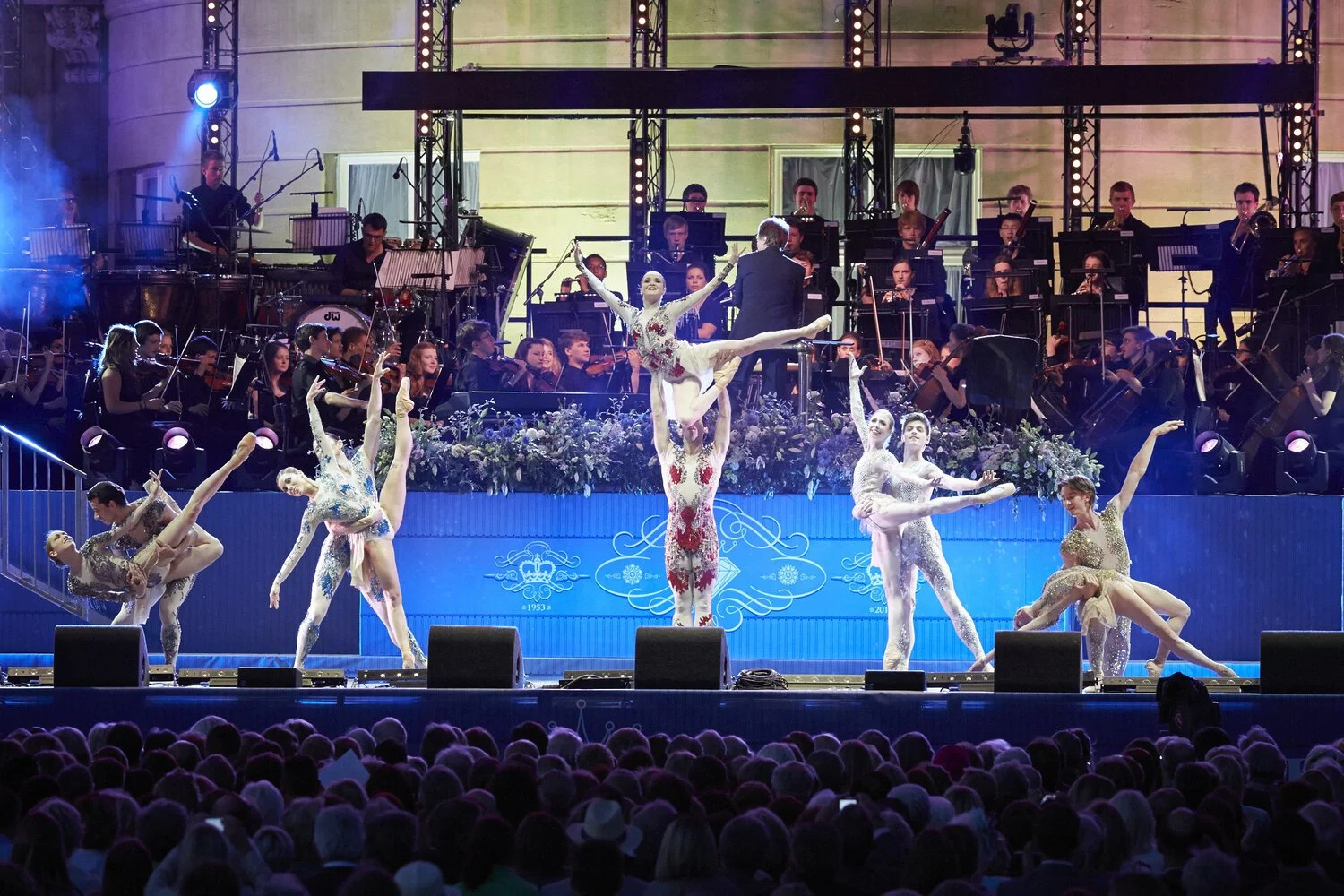
Yet Undreamt is an eight-minute orchestral work commissioned by Raymond Gubbay Ltd. for The Queen’s Coronation Festival Gala. It was performed by the National Youth Orchestra of Great Britain, conducted by Anthony Inglis, and the English National Ballet, choreographed by George Williamson. It was performed July 11, 2013 at Buckingham Palace, and broadcast on television (BBC 1), and radio (BBC 2).
The Window
2012 | 20'
Commissioned by Rambert Dance Company
Choreography by Dane Hurst
Costume and set design by Nicolai Hart-Hansen
Lighting Design by Paul Green
for flute (=picc&afl), clarinet (=bcl), trumpet, horn, percussion, harp, violin, viola, violoncello and double bass

Commissioned by Rambert Dance Company as part of the Season of New Choreography 2012, and premiered at the Queen Elizabeth Hall, Southbank Centre, 31 May 2012.
Choreographer Dane Hurst described the work as follows:
The most devastating phenomenon to affect the residents of old South End was undoubtedly the Group Areas Act. The Act was part of a clutch of apartheid laws passed after the National Party came to power in 1948; it was intended to give effect to the Population Registration Act of 1950 which labelled and classified all South Africans as part of a defined population group. Soon after, evistion noctices were handed out followed by protests and unrest; but inevitably thousands of families were displaces and homes demolished.
The Window isolates a particular household and imagines a particular scenario, looking into what might have happened.
– Dane Hurst
-
“Most thematically ambitious and sophisticatedly realised, The Window (choreographer: Dane Hurst) hones in on a fictitious 1950’s South End household during the period of unrest succeeding the Group Areas Act. With a simple, yet evocative set from Nicolai Hart-Hansen - standing lamp, table and slatted doors - Hurst weaves an emotionally complex but structurally tight story which swells effectively in a striking interrogation sequence and a wrenching ensemble section that pulsates around a kitchen table. Christopher Mayo’s score both reflects and builds the unyielding, tenebrous atmosphere throughout.”
— SARAH WILKINSON, THE STAGE
“Dane Hurst’s The Window is the most ambitious in scale. A sociopolitical piece about the apartheid of 1950s South Africa, it sees 12 dancers deployed in tight rhythmic set pieces to Christopher Mayo’s score. We see the sorrowing women and the brutalising police, and witness their confrontation against a slatted township set, and what’s striking about all of this is its deja-vu quality. Thematically and stylistically, The Window is deeply indebted to the work of Rambert’s former artistic director Christopher Bruce, with Ghost Dances and Swansong its most obvious antecedents. It’s a promising and well-finished work.”
— LUKE JENNINGS, THE GUARDIAN